Charging guides · Off-peak charging
Scheduled charger, car schedule or Octopus app: which one should decide when your car charges?
The question comes up in every owners' group: my charger is set to 00:30–05:30, does that still work if I also set something in the car, or in an app? The short answer is yes, as long as you know which schedule actually decides. There are up to three of them, and they don't talk to each other.
The rule: the car charges only when every schedule says yes
Think of each schedule as a gate on the same cable:
- the charger's schedule decides whether power is available at all;
- the car's schedule (in the car's screen or the MyPeugeot, MyVauxhall, MyCitroën or MyDS app) decides whether the car accepts it;
- an energy app that drives the charger or the car (Intelligent Octopus Go, for instance) opens and closes one of those two gates for you.
Charging happens only while every gate is open. Two schedules that overlap give you the overlap. Two schedules that don't overlap give you nothing, and a car that is still at 30% in the morning. That's the most common "it stopped working" story: a charger moved to a new window while the car kept the old one.
The catch with the car's own schedule
On most Peugeot, Vauxhall, Citroën, Opel and DS electric cars built from 2019 to 2024 (e-208, e-2008, Corsa Electric, Mokka Electric, ë-C4, DS 3 and the vans), the car's delayed charging is a start time, once a day. There is no end time. Set it to 00:30 and the car starts at 00:30, then keeps going until the battery is full.
On a 7.4 kW home charger, an e-208 needs roughly 5 h 40 to go from 20% to 100%. Started at 00:30, it finishes around 06:10: the last 40 minutes are at peak rate. That's why some owners on Octopus Go end up setting an alarm for 05:30 to stop the car by hand.
Who stops the charge? Same car, 20% at midnight, Octopus Go window
On Octopus Go: let the charger hold the window
Octopus Go gives you a fixed cheap window every night, from 00:30 to 05:30 (UK time). The simplest set-up that never overruns:
- Schedule the charger to 00:30–05:30 in its own app (Ohme, Hypervolt, Zappi, Wallbox, Pod Point…).
- Set the car to charge immediately, with no delayed start: it accepts power as soon as the charger offers it.
- Plug in when you get home. Nothing happens until 00:30, and the charger cuts power at 05:30 whatever the car thinks.
The charger can't read the battery level, so it won't stop at 80%: it simply stops at 05:30. If you also want a limit, set it in the car if yours has one, or use something that reads the car's level (see below). If your charger has no schedule, the second-best option is the car's start time at 00:30, keeping in mind that a low battery will run past 05:30.
Check the car's clock after the change to winter time. The car compares its start time with its own clock, and not every car changes hour. On the cars Voltena follows, about one scheduled charge in five started an hour early in the days after 25 October 2026, because the car was still on summer time. If yours starts at 23:30 instead of 00:30, look at the clock on the dashboard.
On Intelligent Octopus Go: Octopus is already in charge
Intelligent Octopus Go works differently. You tell the Octopus app how much charge you want and by when, and Octopus decides when to charge: in the cheap window from 23:30 to 05:30, and sometimes in extra slots outside it when the grid has spare power, still at the cheap rate (up to six hours of smart charging a day; beyond that, it's billed at the peak rate). To do that, Octopus drives either the car directly or your charger.
For a Peugeot, Vauxhall, Citroën, Opel or DS, it's the charger: none of these makes is among the cars Octopus lists for direct integration. You need a compatible charger (Octopus names its own and the Ohme; several other makers say theirs work too). Octopus's eligibility checker gives the definitive answer for your charger.
The consequence: don't add a second schedule on top. A delayed start in the car, a schedule in the charger's app or another charging app will close a gate just when Octopus opens one, and the charge it planned won't happen. Charger makers say the same: Ohme lists the car's own schedules and delayed charging among the usual causes of a charge that stays suspended. Leave the car on immediate charging and let Octopus decide. The same goes for other smart tariffs that drive the charger, such as OVO Charge Anytime or EDF's smart charging option.
Where an app like Voltena fits
The car's start time can't stop the charge; the charger's schedule can't see the battery. An app connected to the car itself can do both: start when the window opens, read the level as the car charges, and stop at the limit you chose or when the window ends.
- With a scheduled charger on Octopus Go: keep the charger on 00:30–05:30 and enter the same window in the app. It starts at 00:30 and stops at 80% (or your limit) instead of 05:30.
- With a charger that has no schedule: the app holds the window on its own.
- On Intelligent Octopus Go: pick one. Either Octopus plans the charge, or the app does; not both, for the same reason as above.
Frequently asked questions
My charger is on a schedule and I set a start time in the car. Is that a problem?
It can be. The car only charges in the overlap, and a car whose start time falls outside the charger's window may not charge at all. You gain nothing from two schedules: keep the charger's, and set the car to immediate charging.
Why does my car still go to 100% when my charger is scheduled?
Because the charger only knows the time, not the battery level. Five hours on a 7.4 kW charger add around 33 kWh, which is more than most nights need. Either shorten the charger's window, or use a limit that reads the car's level.
The cheap window ends at 05:30 but my car keeps charging. Why?
Your charger has no schedule, or it's set to "always on", and the car's own delayed start has no end time. Schedule the charger, or use an app that stops the car at the end of the window.
Does the car need to be plugged in before the window opens?
Yes, plug in when you get home. With a scheduled charger, nothing flows until the window opens; the car waits.
Start in the cheap window, stop at 80% or when it ends
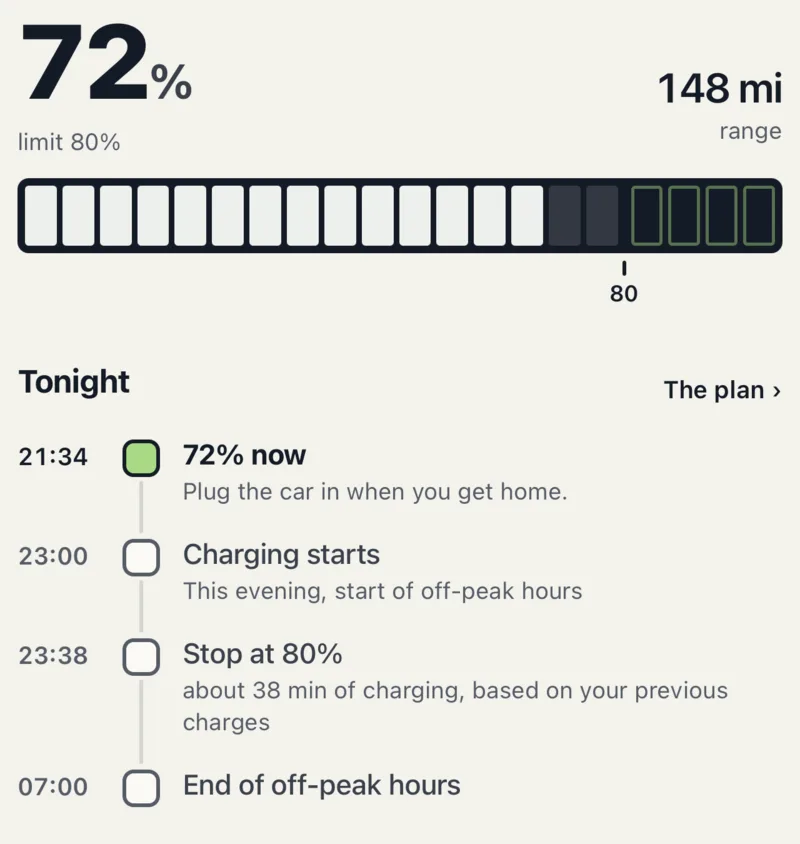
Enter your off-peak window in Voltena: it starts the charge when the window opens, stops it at the limit you choose or when the window ends, whichever comes first, and works out what each charge cost on your tariff. No extra box, no rewiring, and your charger's own schedule can stay as it is.


14 days free, then £44.99 a year.
Sources
- Octopus Go: cheap rate between 00:30 and 05:30 every night (Octopus Energy)
- Intelligent Octopus Go eligibility: 23:30–05:30 and smart charging slots (Octopus Energy)
- Intelligent Octopus Go FAQs: car or charger integration (Octopus Energy)
- Intelligent Octopus Go: the six-hour smart charging limit (Octopus Energy blog, May 2026)
- Troubleshooting suspended EV errors: car schedules that conflict with the charger (Ohme)
- Charge Anytime: a compatible car or a compatible charger (OVO Energy)
- Peugeot e-208 handbook: immediate or deferred charging, programmed from the app (pp. 145–147)