Charging guides · Battery
Built-in 80% charge limit: which Peugeot, Vauxhall and Citroën EVs have it, and what it doesn't do
Every time someone posts about stopping a Peugeot or a Vauxhall at 80%, the same replies follow: "my 2025 car already does that in the app", "I can't find the option on my 2026", "what's the point anyway?" They're all partly right. Whether your car has a built-in limit depends on its platform and model year, not on the badge, and the limit does one thing only.
Which cars have a built-in limit
Where an AC charge stops on its own, by car
The dividing line is the platform. The cars launched in 2019–2020 on Stellantis's small-car electric platform (e-208, e-2008, Corsa-e, Mokka-e, ë-C4, DS 3 Crossback E-Tense and the vans) were built without a charge limit: in the car, in MyPeugeot, MyVauxhall or MyCitroën, there is simply no setting. The newer, larger platform (e-3008, e-5008, Grandland Electric) has an 80% limit from the start; on the Grandland it's even the default, called Battery Care Mode.
The small cars caught up in 2025. Peugeot added an 80% AC limit with the April 2025 e-208 update (51 kWh usable, around 270 miles WLTP), Vauxhall lists an "80% charging limitation function" for the 2025 model-year Corsa Electric, and Citroën brought it to the ë-C4 with the Collection 2025 range. Whether cars delivered before those updates can get it by software hasn't been announced. The ë-C3 and Frontera Electric, on another new platform, don't have it, and for a good reason (see below).
The model year matters more than the registration date: a car registered in early 2025 may have been built before the update. If in doubt, the charging menu in the car is the answer.
Where to find the setting
- In the car first. On the central screen, open the energy or charging settings (the exact menu name depends on the model and software version) and look for the 80% limit or Battery Care Mode.
- Then in the app. MyPeugeot, MyVauxhall and MyCitroën can show the same option in their charging controls. Owners of some 2025–2026 cars report that it only appeared in the app after they had found it in the car; if it's missing in the app, check there before concluding your car doesn't have it.
- Switch it off before a long trip, the night before, if you need the full range. On the e-3008 and e-5008, Peugeot also asks you to switch it off for battery heating on a home charge to work.
Wherever we could check, the limit is 80%: a switch you turn on or off, not a level you choose. And it applies to AC charging only. On a rapid DC charger the car charges as usual; the charge slows down sharply past 80% anyway, which is why most people unplug there.
Is stopping at 80% actually worth it?
This is the part that starts arguments, so here's the balanced version.
- For the NMC batteries of the e-208, Corsa, e-2008 and their cousins, an 80% habit is gentle and costs nothing if 80% covers your day. Lithium-ion cells age a little faster when they sit at a high charge for hours, especially in the heat; the effect is real but modest, and the 100% on the screen isn't quite 100% of the cells: the car keeps a reserve you can't use. Vauxhall itself recommends charging to a maximum of 80% for daily use. The Peugeot e-208 handbook has no such advice, which is why owners disagree.
- Charge to 100% whenever you need the range. A full charge before a long drive does no harm; what's worth avoiding is a car left at 100% for days.
- LFP batteries are the exception. The ë-C3 and Frontera Electric use LFP cells, which age differently and need full charges to read their own level correctly. Citroën's handbook asks you to charge to 100% and to do a complete slow AC charge at least once every four charges. On those cars, an 80% limit would be the wrong habit.
And if 80% leaves you short every day, as some owners of the original 50 kWh e-208 point out, charge higher. A battery is there to be used.
What a built-in limit doesn't do
The limit decides where a charge stops. It says nothing about when it happens or what it costs:
- It doesn't stop at the end of your cheap window. On an off-peak tariff such as Octopus Go (00:30–05:30), a car that started late or from low can still be charging after the window ends, at peak rate.
- It doesn't follow your tariff. On the 2019–2024 cars, the car's delayed charging is a single start time a day: a second cheap window (an afternoon, a weekend) means starting the charge by hand.
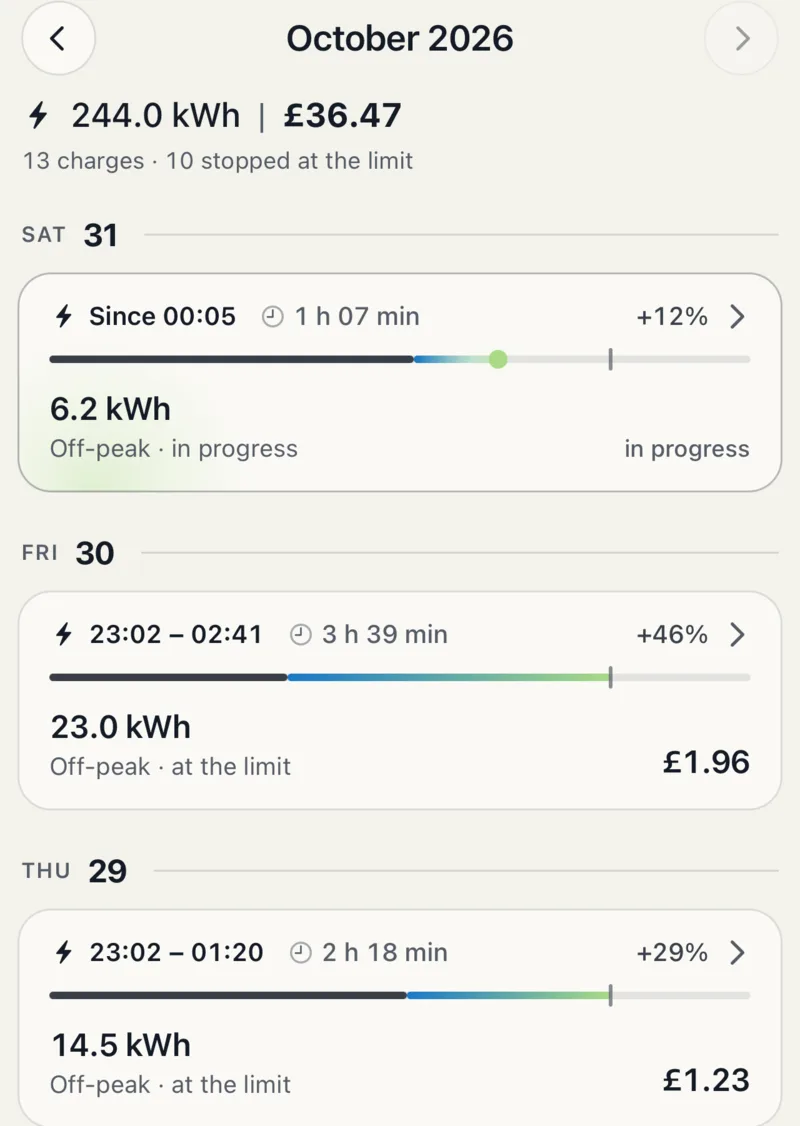
- It doesn't tell you what each charge cost. The app shows the level, not the pounds.
A scheduled wallbox covers part of this: it cuts the power when the window ends. Our guide on scheduled chargers, car schedules and Octopus explains how to make the two work together.
Frequently asked questions
My 2025 e-208 doesn't show the 80% option. Is it broken?
Probably not. Check the car's charging menu before the app, and check when the car was built: a 2025 registration can be a car built before the April 2025 update, which doesn't have the setting.
Can an app override my car's built-in limit?
No. The car's limit still applies, whatever an app asks. If an app stops the charge earlier, at 70% for instance, the lower of the two wins.
Does the limit apply on rapid chargers?
No, AC only. At a rapid charger, set your stop in the charger's app or unplug: charging slows down past 80% anyway.
Should I charge to 100% once in a while to "calibrate" the battery?
On LFP cars (ë-C3, Frontera), yes: Citroën asks for it. On the NMC cars, Peugeot's handbook doesn't ask for it; a full charge before a long trip happens naturally anyway.
Your car stops at 80%. Now make it charge at the right time
A built-in limit decides where the charge stops, not when it happens or what it costs. Voltena starts the charge when your off-peak window opens, stops it when the window ends, and shows what every charge cost on your tariff. Your car's own limit stays as it is.


14 days free, then £44.99 a year.
Sources
- Peugeot e-3008 and e-5008 battery heating: works when the 80% charge limit is disabled (electrive, September 2025)
- Charging and range: Battery Care Mode 80% is the default on Grandland; 80% recommended for daily use (Vauxhall)
- Stellantis small cars get more range: 51 kWh e-208 with 80% AC limit, April 2025 (electrive.net, German)
- Vauxhall 25MY price and specification guide: 80% charging limitation function (Vauxhall, November 2025)
- Citroën ë-C4 Collection 2025: the 80% limit arrives in the infotainment (Automobile Propre, French)
- Citroën C3 handbook: charge the vehicle to 100%, full AC charge at least once every four charges
- Peugeot e-208 handbook: charging, no need to wait for the reserve level (p. 140)
- Citroën ë-C3: 44 kWh LFP battery (EV Database)